For logistics and transport operators, protecting cargo is not simply about securing a trailer when it is parked.
Trailers move between depots, customer sites, distribution centres and parking locations, often carrying valuable loads while operating away from a company's main premises.
That creates a very different protection challenge.
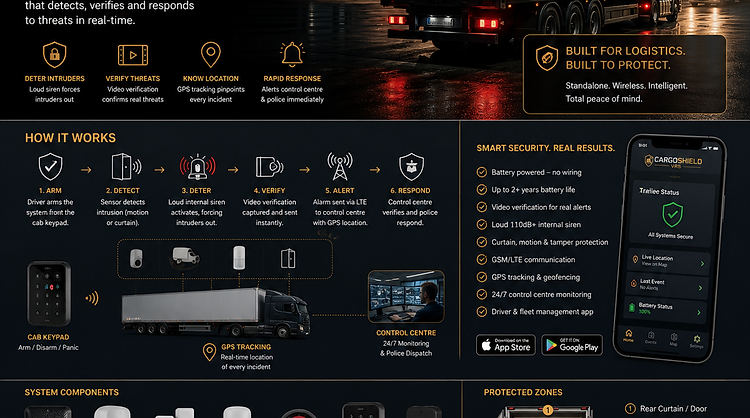
Cargo Shield VRS from Revolution IoT is designed around that challenge — bringing detection, deterrence, verification, location awareness and response together in one connected solution for trailers and logistics fleets.
Rather than relying on a single device or sensor, the Cargo Shield VRS concept creates layers of protection around the trailer and the cargo inside it.
From Detection to Verified Response
The principle behind Cargo Shield VRS is straightforward:
Arm → Detect → Deter → Verify → Alert → Respond
Once the system is armed, configured sensors can monitor selected areas of the trailer for activity associated with unauthorised access.
Depending on the installation, this can include monitoring of rear doors or curtains, internal movement, side curtains and equipment tampering.
When an event occurs, Cargo Shield VRS is designed to do more than simply generate an alarm.
A local audible warning can provide an immediate deterrent, while connected communications can transmit information relating to the incident.
Where video verification is configured, visual information can help establish what has actually happened rather than treating every activation identically.
Location information can also associate an incident with the position of the trailer.
The result is a much more useful picture:
- What happened?
- Which trailer was affected?
- Where did it happen?
- Which protected zone activated?
- Is visual verification available?
- What action needs to happen next?
That is the difference between a standalone alarm and a connected fleet-protection platform.
Protection Designed Around the Trailer
Every fleet and trailer configuration is different, so Cargo Shield VRS should not be viewed as a one-size-fits-all package.
Depending on the required installation, protected areas can potentially include:
- Rear curtain or door
- Front internal movement
- Rear internal movement
- Side curtain
- Cab keypad/panic functions
- Control-panel or siren tamper protection
Potential system components can include a battery-powered alarm/control panel, PIR video sensor, curtain/door contacts, internal PIR detection, audible deterrence, cab keypad, GPS tracking and LTE/GSM connectivity.
The exact combination should be designed around the trailer, cargo, operating environment and customer's required response procedure.
The Importance of Video Verification
An alarm tells an operator that something has happened.
Verification can tell them considerably more.
Where Cargo Shield VRS is configured with video verification, an alarm event can be accompanied by visual information that assists an operator in assessing the incident.
This can be particularly valuable in mobile environments because a trailer may be a considerable distance from the fleet's main premises when an activation occurs.
The objective is not simply to collect more information.
It is to provide better information when a decision needs to be made.
Location and Incident Intelligence
Location adds another important layer.
When GPS functionality is incorporated into the system, an incident can be associated with the trailer's location.
For a fleet operator managing numerous trailers across different depots, routes and customer locations, that provides considerably more context than receiving a generic alarm notification.
Cargo Shield VRS is therefore intended to bring several pieces of incident information together:
Trailer + Event + Location + Verification + Response
Over time, event history can also create a useful operational record of activity associated with individual trailers.
A Fleet-Level View
One of the most interesting opportunities for Cargo Shield VRS is moving beyond individual trailer protection into fleet-wide visibility.
The Cargo Shield dashboard concept envisages a fleet operator being able to see information such as trailer identity, armed/disarmed condition, battery status, GPS position, communication condition, protected-zone status and incident history from a central interface.
The concept also provides for searching individual trailers and reviewing events associated with a particular vehicle.
This is important because the challenge changes as fleets grow.
Protecting one trailer is one thing.
Understanding the status of dozens or potentially hundreds of connected assets is another.
Cargo Shield VRS has the potential to provide fleet managers with a much clearer operational view of those protected assets.
Designed for the Realities of Logistics
A trailer-protection solution needs to work in an environment where permanent wired infrastructure may not always be practical.
That is why the Cargo Shield VRS concept places particular emphasis on connected and battery-powered technology.
Where supported by the final hardware configuration, this approach can be particularly relevant to trailers and assets that spend substantial periods away from fixed sites or power sources.
It means the protection concept can follow the trailer rather than ending at the depot gate.
Connected Technology With a Clear Purpose
There is an important distinction between adding IoT technology simply because it is available and using connectivity to solve an actual operational problem.
For Cargo Shield VRS, every connected element should have a purpose.
- Detection identifies the event.
- Deterrence challenges the intrusion.
- Video provides verification.
- GPS provides location context.
- LTE/GSM provides communications.
- The platform brings that information together.
- The response workflow turns information into action.
That is the Revolution IoT approach:
Connected intelligence that provides useful information when and where it is needed.
The Next Stage of Cargo Shield VRS
The Cargo Shield VRS development concept goes further.
The supplied roadmap envisages integration between real hardware and a secure backend capable of receiving alarm, location and video information, managing devices and users, and supporting live alerts.
The longer-term concept also considers web/mobile deployment, role-based access, audit logging and reporting around incidents, response, battery condition and operational information.
These development-stage capabilities should be clearly distinguished from functions that are already commercially deployed. The roadmap represents a development direction, not existing production functionality, unless independently verified.
Protect What Matters Most
Cargo theft is not just about the value of the goods inside a trailer.
An incident can create operational disruption, delivery problems, customer issues and significant demands on fleet-management teams.
Cargo Shield VRS is being developed around a simple principle:
Protect what matters most.
By combining connected detection, deterrence, verification, communications, location intelligence and response workflow, Revolution IoT is developing Cargo Shield VRS as a purpose-built approach to protecting trailers and cargo in a connected logistics environment.
Cargo Shield VRS
Built for Logistics. Built to Protect.
Interested in seeing Cargo Shield VRS in action? Explore Cargo Shield VRS to review the full product presentation, or contact Revolution IoT to arrange a demonstration and discuss a Cargo Shield configuration for your fleet.