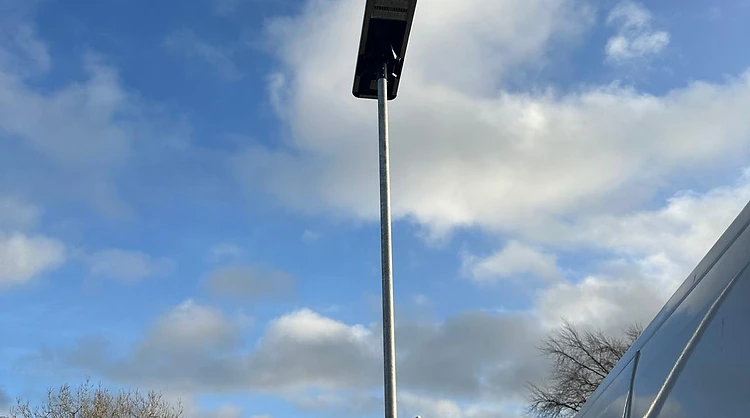
The Challenge of Lighting Where Infrastructure Isn't Available
When lighting is required in a location without readily available power, cabling or supporting infrastructure, a conventional installation can quickly become a significant civil-engineering project.
Trenching for electrical supply, running armoured cable from the nearest distribution point, installing ducting, making good the surface, connecting to the grid, and commissioning a standard street-lighting circuit — each step adds time, cost and disruption. In remote or semi-rural locations, the nearest electrical supply may be hundreds of metres away, or may not exist at all.
The challenge is not only the cost. It is the disruption. Trenching through a finished car park, a public pathway or a roadside verge is invasive. It requires plant, labour and often road-opening licences. And in environmentally sensitive locations — near water, in protected habitats or in areas where ground disturbance is restricted — conventional trenching may not be practical at all.
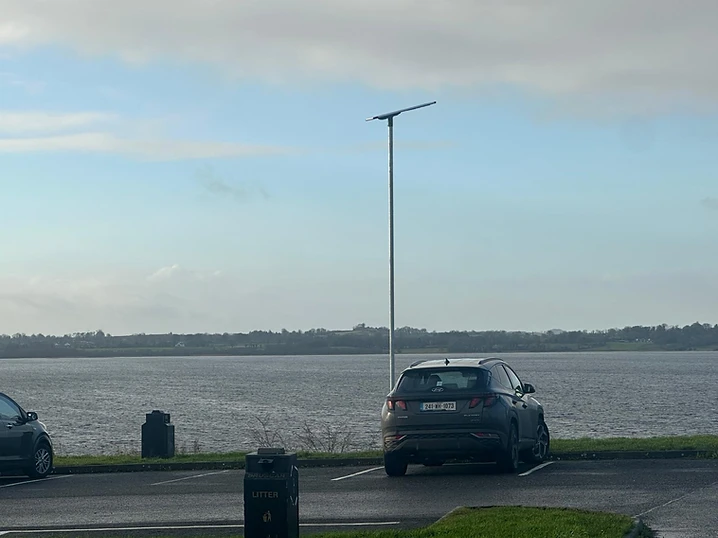
For local authorities, facility operators and site managers, this creates a familiar problem: a location that needs lighting, but where providing it conventionally would be disproportionately expensive, slow or disruptive.
Light Defender: A Different Approach
Light Defender provides a different approach: a self-contained solar-powered lighting solution designed for locations where conventional electrical infrastructure is unavailable, difficult to install or impractical.
Instead of drawing power from the grid, Light Defender generates its own energy from integrated solar panels. Instead of relying on cabled infrastructure, it is a standalone unit — a pole-mounted, self-contained system that can be installed in a suitable location without trenching, cabling or grid connection.
The practical concept is straightforward:
- Solar energy. Integrated solar generation captures energy during daylight hours.
- Battery storage. Stored energy allows the light to operate after dark.
- Integrated lighting. LED lighting provides illumination when it is needed.
- Standalone installation. The unit is self-contained — no mains cabling required.
- Reduced infrastructure dependency. No trenching, no grid connection, no electrical distribution.
- Suitability for remote locations. The system is designed for sites where conventional infrastructure is unavailable or impractical.
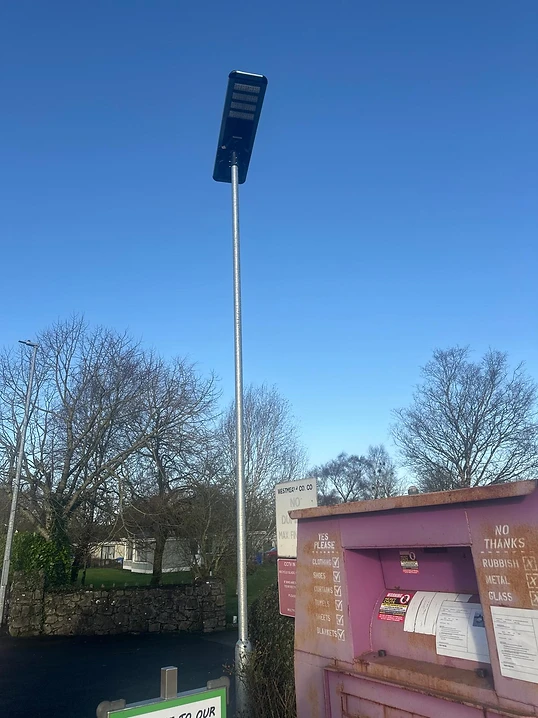

This makes Light Defender suitable for a range of locations where conventional lighting would be difficult, slow or uneconomical — including remote car parks, recycling bring centres, public pathways, construction sites and off-grid facilities.
Light Defender in Westmeath
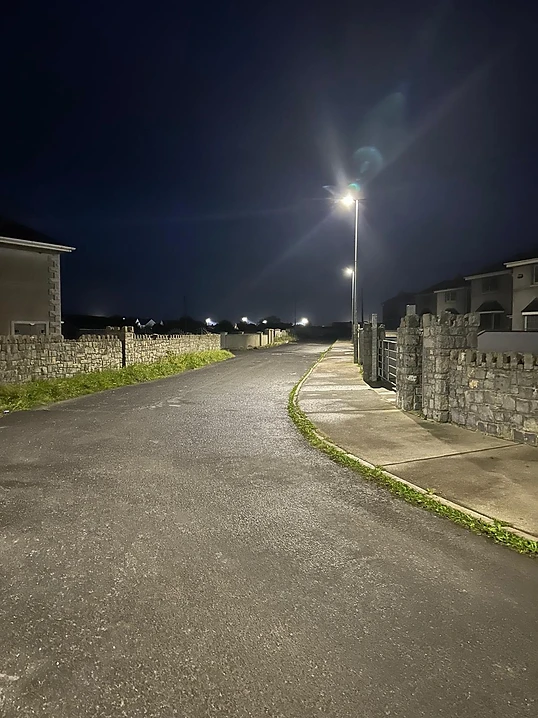
According to information supplied by Revolution IoT, Light Defender has been deployed in Westmeath in conjunction with Westmeath County Council.
The scheme has been piloted over approximately the past 12 months. The objective has been to provide effective lighting in locations where conventional lighting infrastructure was unavailable or difficult to provide.
According to information supplied by Revolution IoT, Shane Boyle of Westmeath County Council has regarded the pilot as successful, and the deployment has subsequently been expanded to additional locations.
The deployment demonstrates a practical response to a real infrastructure challenge. Rather than undertaking civil works to extend electrical supply to each location, the approach uses standalone solar-powered units to provide lighting where it is needed — without the trenching, cabling and grid dependency of a conventional installation.
From Pilot to Wider Deployment
The significance of the project is not simply that the technology worked in one location. Following the initial pilot period, the Light Defender approach has been extended to additional locations, demonstrating how standalone solar lighting can provide a practical option across different site types.
The additional locations are understood to include areas such as bring centres and similar public facilities. The exact deployment list is being confirmed.
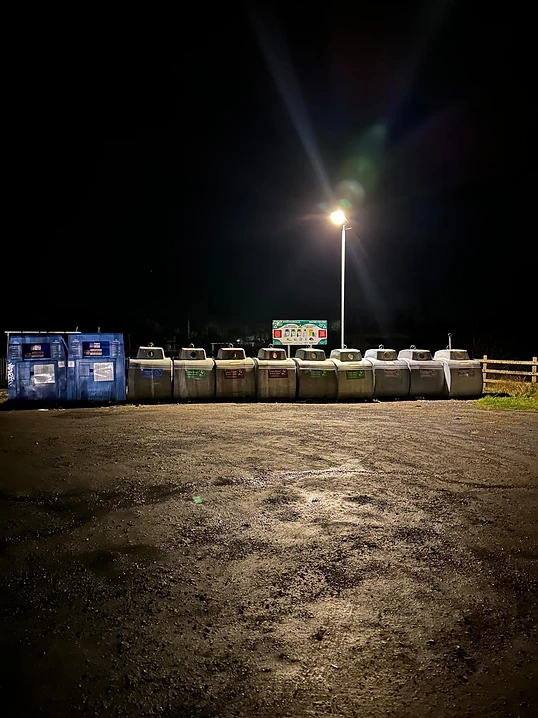

This expansion is notable. A single installation can be dismissed as a one-off. But when a local authority extends a pilot to additional locations, it suggests the approach is being evaluated as a practical option — not just a single-site trial.
Why Solar Lighting Matters
For locations where conventional lighting infrastructure is unavailable, solar lighting offers a practical alternative. But the value is not simply avoiding the cost of a cable. It is the ability to provide lighting in places where it would otherwise be impractical.
Consider the locations where standalone solar lighting is most relevant:
- Remote car parks and parking areas — where the nearest electrical supply may be distant or non-existent
- Recycling bring centres — often located in rural or semi-rural locations away from built-up areas
- Public pathways and walkways — where trenching would disrupt the surface and the surrounding environment
- Construction sites — where temporary lighting is needed and mains power may not yet be connected
- Off-grid facilities — where no electrical infrastructure is available at all
- Temporary events — where lighting is needed for a defined period without permanent installation
In each case, the common factor is the same: conventional lighting would require infrastructure that is unavailable, expensive, slow to install or disruptive to the location.
Conventional Installation vs Light Defender
The difference between conventional lighting installation and a standalone solar approach is structural.
Conventional installation typically requires:
- A connection to the electrical grid
- Trenching and cabling from the nearest distribution point
- Civil works including ducting, surface reinstatement and making good
- Electrical distribution infrastructure
- Ongoing dependency on the grid for power
Light Defender takes a different approach:
- Standalone solar generation — no grid connection required
- Integrated energy storage — power available after dark
- Self-contained lighting — no external power source
- Reduced infrastructure dependency — no trenching or cabling
- Potentially simpler deployment in suitable locations
This is not to say that solar lighting replaces conventional lighting in every situation. In built-up urban areas with established electrical infrastructure, conventional grid-connected lighting remains the standard. But in locations where that infrastructure is not available — or where extending it would be disproportionately expensive or disruptive — standalone solar lighting provides a practical alternative.

Practical Considerations
For local authorities evaluating solar lighting, several practical considerations apply:
- Site suitability. Solar lighting requires sufficient daylight exposure. Locations with heavy shading from trees or buildings may not be suitable without careful positioning.
- Installation. While trenching is avoided, the unit still requires a secure foundation and pole installation. This is typically simpler and faster than a conventional installation but is not zero-work.
- Maintenance. Solar panels require periodic cleaning to maintain efficiency. Battery life depends on usage patterns and environmental conditions.
- Lighting performance. Solar lighting provides illumination after dark, but the intensity and duration of lighting depend on the configuration, battery capacity and solar input.
These considerations are part of the reason the Westmeath pilot has been valuable. It has provided real-world experience of how the technology performs in actual public locations over an extended period — not just in theory or in a single short-term test.
The Broader Context
The need for off-grid lighting is not unique to Westmeath. Across Ireland, local authorities, community groups and facility operators face similar challenges at recycling bring centres, remote car parks, public pathways and off-grid facilities.
In many cases, these locations have gone unlit — not because lighting was not needed, but because the cost and disruption of providing it conventionally was disproportionate. A standalone solar approach changes the calculation. When the cost of trenching, cabling and grid connection is removed from the equation, the case for lighting a location can become practical where it previously was not.
A Practical Option, Proven in the Field
The Westmeath deployment does not claim that solar lighting is the answer to every lighting challenge. What it demonstrates is that for locations where conventional infrastructure is unavailable or impractical, a standalone solar-powered approach can provide effective lighting — and that a local authority has found it worth extending beyond a single site.
For organisations facing similar challenges, the question is not whether solar lighting replaces conventional lighting. It is whether there are locations where the standalone approach is the practical option.
Explore Light Defender to learn more about solar-powered remote-site protection, or talk to Revolution IoT about a deployment.